Is ChatGPT Safe for Mental Health? What You Need to Know
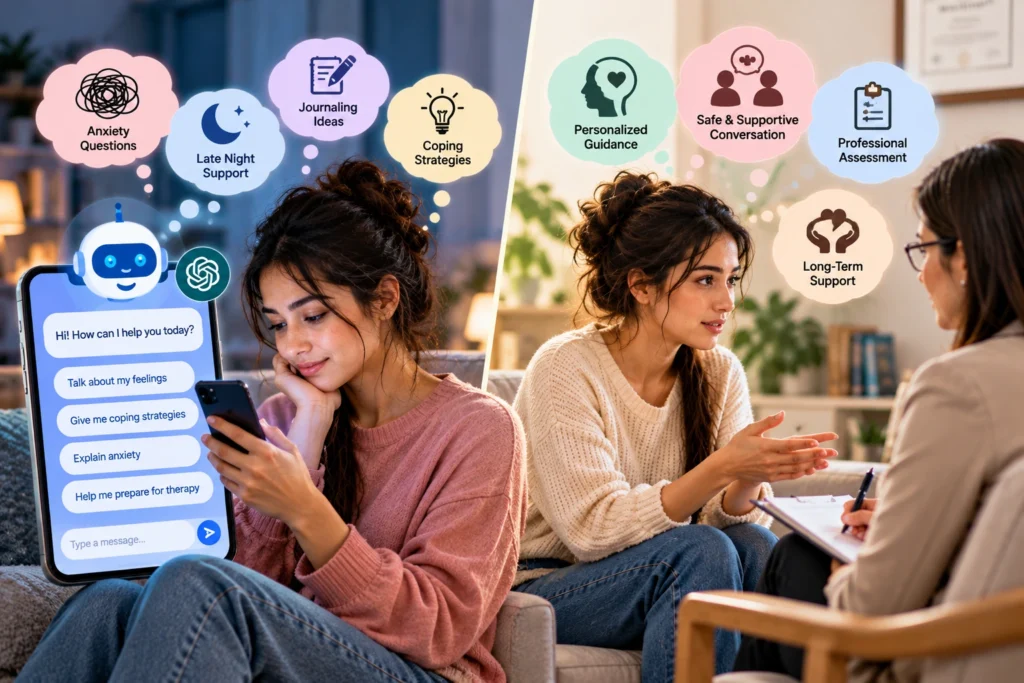
Is ChatGPT safe for mental health? It can be useful for general information, journaling, preparing questions for an appointment, and organizing thoughts. However, ChatGPT is not a substitute for a licensed therapist, psychiatrist, or crisis professional. It can generate inaccurate information, misunderstand complex symptoms, and may not recognize when someone needs urgent help. Research has also raised concerns about using general-purpose AI systems for mental-health assessment and treatment.
ChatGPT has become an easy place for people to turn when they have questions about their mental health. Someone feeling anxious might ask why they cannot stop worrying. Someone feeling low may type out what they have been experiencing and ask what it could mean. Others use AI to journal, organize their thoughts, or simply have a conversation when they do not know who else to talk to.
But this raises an important question: Is ChatGPT actually safe for mental health?
The answer is not simply yes or no. While ChatGPT provides quick, accessible answers for general knowledge and everyday queries, it shouldn’t be treated as an authoritative, error-free source for specialized or high-stakes information. At the same time, it has important limitations. It is not a therapist, psychiatrist, or crisis counselor, and it should not be used as a replacement for professional mental health care. The American Psychological Association has also warned that general-purpose AI tools should not be considered a safe or effective replacement for care from a licensed mental health professional.
Is ChatGPT Safe for Mental Health?
ChatGPT can provide a helpful conversation, but a helpful conversation is not the same thing as mental health treatment.
When you ask ChatGPT about anxiety or depression, it generates a response based on patterns in the information it has learned. It does not sit down with you, review your medical and personal history, observe changes in your behavior, or conduct a clinical assessment in the way a trained mental health professional can.
This distinction is easy to overlook because AI responses can sound very understanding and personal. A response may even describe your situation in a way that feels surprisingly accurate. That does not necessarily mean the AI understands what is actually happening or that its conclusion is clinically correct.
There is already peer-reviewed research showing concerns about ChatGPT’s performance in mental-health contexts. For example, a Frontiers in Psychiatry study found that as clinical scenarios became more complex, ChatGPT’s recommendations could become inappropriate or potentially dangerous, and highlighted its inability to perform clinical judgment and gather necessary information like a clinician. That can become a serious problem when someone uses an AI response to decide whether they have a mental health disorder, whether they should take or stop a medication, or whether they need professional help.
It is better to think of ChatGPT as a general information and support tool, rather than a mental health professional.
Why Are People Turning to ChatGPT for Mental Health Support?
There are understandable reasons people use AI when they are struggling emotionally.
Getting professional help can sometimes feel intimidating. A person may not know whether their symptoms are serious enough to justify an appointment, or they may feel uncomfortable talking about personal problems with another person. ChatGPT is available almost immediately, which can make asking a difficult question feel easier.
Some people also use it because they want to understand what they are experiencing before speaking with a professional. They may ask about anxiety symptoms, depression, panic attacks, stress, relationship difficulties, sleep problems, or other concerns.
There is nothing inherently wrong with wanting information. In fact, learning more about mental health can help someone recognize that what they are experiencing deserves attention.
The problem begins when information from an AI chatbot is treated as a diagnosis or as a substitute for appropriate care.
What Can ChatGPT Actually Help With?
There are situations where ChatGPT can be useful without taking the place of a therapist or psychiatrist.
For example, we explain general mental health terms in simpler language. If you have heard the terms generalized anxiety disorder, panic disorder, depression, or obsessive-compulsive disorder and do not understand what they mean, an AI tool can provide a starting point for learning.
For anyone feeling overwhelmed, AI works remarkably well as a digital sounding board. Writing out a messy brain dump and prompting the tool to spot recurring patterns turns overwhelming thoughts into clear talking points for a healthcare professional.
Another reasonable use is preparing for an appointment. You might use ChatGPT to organize the symptoms you have noticed, think about when they started, or create a list of questions you want to ask your therapist or psychiatrist.
These uses are very different from asking an AI system to tell you what disorder you have.
What ChatGPT Cannot Reliably Do
One of the biggest limitations is diagnosis.
Mental health symptoms often overlap. Trouble sleeping, difficulty concentrating, irritability, fatigue, low mood, or excessive worry can occur for many different reasons. A proper assessment may involve your symptoms, medical history, medications, substance use, lifestyle, relationships, previous treatment, and other factors.
A chatbot generally does not have access to that complete picture.
Even when you provide a lot of information, there is no guarantee that the response will be clinically accurate. This is why an AI-generated answer should not be treated as a formal diagnosis.
The same applies to treatment. ChatGPT may describe different types of therapy or medications, but that does not mean it determine which treatment is appropriate for you. Medication decisions in particular should be discussed with a qualified healthcare professional because factors such as other medications, medical conditions, side effects, dosage, and individual circumstances can matter.
Can ChatGPT Replace a therapist?
No.
The difference between an AI chatbot and a therapist is much bigger than simply having a human on one side and a computer on the other.
Therapy involves an ongoing professional relationship. A therapist learns about a person’s history, notices change over time, asks follow-up questions, recognizes patterns, and adjusts the therapeutic approach based on what is happening.
A mental health professional is also responsible for making appropriate clinical decisions within their scope of practice.
ChatGPT can respond to what you type, but it does not have the same clinical responsibility or ability to understand your life in its full context.
The conversation may feel supportive, but that feeling should not be confused with receiving professional therapy.
Can ChatGPT Help with Anxiety or Depression?
We provide general information and may help someone think through what they are experiencing, but it should not be considered a treatment for anxiety or depression.
For example, someone dealing with occasional stress might use ChatGPT to generate journaling prompts, learn about relaxation techniques, or organize their thoughts before talking to someone.
But persistent anxiety or depression can be more complicated. If worry, sadness, loss of interest, hopelessness, sleep problems, panic symptoms, or difficulty functioning continue for weeks or begin affecting work, relationships, school, or everyday life, it is worth considering professional support.
An AI chatbot cannot determine whether those symptoms are caused by an anxiety disorder, depression treatment, another mental health condition, a physical health problem, medication, substance use, or a combination of factors.
That is where a professional assessment becomes important.
What Are the Risks of Using ChatGPT for Mental Health?
One concern is simply that AI can get things wrong.
A response can sound convincing and still be inaccurate. If someone accepts that answer without checking it, they may misunderstand their symptoms or make decisions that are not appropriate for their situation.
The risk of receiving reassurance when reassurance is not helpful. For someone who repeatedly worries about their health or repeatedly checks whether something is wrong, asking an AI chatbot the same question over and over may become part of that cycle rather than solving the underlying problem.
AI may not recognize the seriousness of a situation. A trained professional can ask additional questions and look at the broader context when assessing someone’s mental health. A chatbot may not recognize important warning signs, especially if the person has not explained everything clearly.
Can I tell ChatGPT my mental-health problems? People may share extremely personal information with AI because the interaction feels private and conversational. Before doing so, it is important to understand how the particular AI service handles information. A person should not automatically assume that an AI conversation has the same confidentiality protections as a conversation with a healthcare professional.
The possibility of becoming too dependent on the chatbot. If someone starts using AI instead of speaking with friends, family, therapists, psychiatrists, or other sources of real-world support, the technology may actually make it harder to get the help they need.
Is ChatGPT safe?
“No. Although AI can imitate a conversational style and sound supportive, it is not equivalent to psychotherapy. To truly understand what psychotherapy is and how treatment works, we must look beyond algorithmic simulation to the evidence-based practices and human connections that drive real healing.”
Professional therapy is based on assessment, clinical knowledge, therapeutic techniques, and an ongoing relationship between the patient and clinician. The treatment can change as the person’s symptoms and circumstances change.
AI can offer valuable support, but it should enhance rather than replace human expertise. For example, someone might use it to keep track of questions they want to discuss in therapy or to learn more about a condition after receiving a professional diagnosis.
While AI assists with specific stages of a mental health journey, human clinical care remains irreplaceable.
How Can You Use ChatGPT More Safely?
If you choose to use ChatGPT for mental health-related questions, it helps to keep realistic boundaries around what the technology can and cannot do.
Use it to learn, organize your thoughts, or explore general information rather than asking it to diagnose you. When practicing responsible AI for mental health and well-being, always verify important health information with a qualified professional instead of assuming the AI is correct.
It is also sensible to be careful about the personal information you share. You do not need to provide your full name, address, medical identification numbers, or other identifying details just to ask a general mental health question.
Most importantly, pay attention to what is happening in your everyday life. If your symptoms are becoming more severe, lasting longer, or interfering with your ability to function, an AI conversation should not become a reason to delay professional care.
When Should You Talk to a Mental Health Professional?
You do not have to wait until a mental health problem becomes overwhelming before asking for help.
If you have been struggling with anxiety, depression, mood changes, persistent stress, intrusive thoughts, sleep problems, relationship difficulties, or other emotional concerns and they are affecting your everyday life, talking with a qualified professional can help you understand what is happening.
Professional care is particularly important when you are unsure what is causing your symptoms or when things you have tried on your own have not helped.
A therapist, psychologist, psychiatrist, or other appropriately qualified provider can look at your individual situation and help determine what type of support may be appropriate.
Seeking help does not mean that something is seriously wrong with you. Sometimes it simply means that you have been dealing with something difficult and would benefit from having someone qualified help you work through it.
What If You Are Having a Mental Health Crisis?
A mental health crisis is different from asking an AI chatbot a general question about stress or anxiety.
If you are thinking about suicide, seriously harming yourself, harming someone else, or you feel that you cannot keep yourself safe, do not rely on ChatGPT for help.
Seek immediate professional assistance through emergency services, a crisis service, an emergency department, or another appropriate resource in your location.
For people in the United States, the 988 Suicide & Crisis Lifeline provides crisis support. In an immediate emergency, call 911 or go to the nearest emergency department.
An AI chatbot can provide information, but it should never be your only source of support during an emergency.
Conclusion
So, is ChatGPT safe for mental health advice?
If you’re using ChatGPT because you’re unsure whether what you’re experiencing is anxiety, depression, ADHD, or another mental health concern, an individualized evaluation can help you understand what’s actually going on. MyPsychiatryCare provides professional mental health care tailored to your symptoms and needs.
FAQ
ChatGPT can be useful for general mental health information and low-risk self-help activities, but it should not replace professional mental health care. AI can produce inaccurate information and may not recognize complex symptoms or safety concerns.
No. ChatGPT should not be relied upon to diagnose anxiety, depression, or another mental health condition. A qualified professional can assess symptoms, medical history, functioning, and other relevant factors to determine an appropriate diagnosis and treatment approach.
No. ChatGPT can provide conversational information and limited supplemental support, but it does not replace the clinical judgment, therapeutic relationship, assessment, and accountability provided by a qualified mental health professional.
You can use it for general information, journaling prompts, or basic coping ideas, but persistent or severe anxiety should be discussed with a qualified professional. AI-generated suggestions should not be treated as individualized medical advice.
No. AI-generated conversations are not equivalent to psychotherapy with a licensed mental health professional. Professional therapy involves individualized assessment, treatment planning, clinical judgment, and an ongoing therapeutic relationship.
Do not rely on ChatGPT or another AI chatbot for emergency care. Contact emergency services, a crisis service, an emergency department, or another appropriate immediate source of professional help in your location.