
The New VA Mental Health Rating Criteria: How Functional Domains Shape Disability Claims
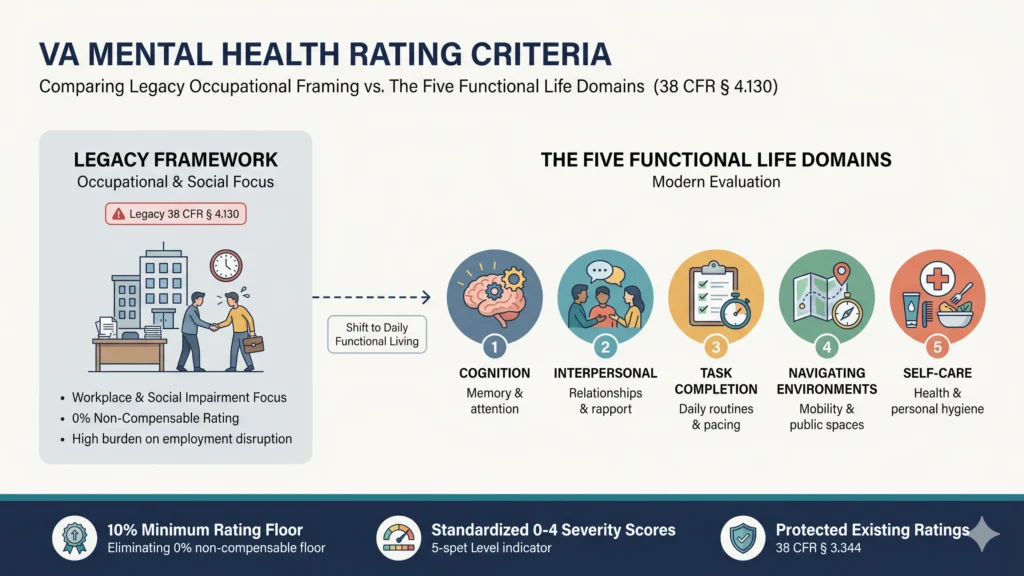
Understanding the new VA mental health rating criteria starts with one central shift: moving away from a narrow focus on job retention and social isolation toward a structured look at how mental health conditions affect everyday functioning across multiple areas of life. Under the Department of Veterans Affairs (VA) rating schedule in 38 CFR § 4.130 (alongside diagnostic rules in 38 CFR § 4.125), proposed updates to the general rating formula for mental disorders organize disability evaluation around five functional domains rather than relying almost exclusively on workplace disruption.
For veterans preparing an initial claim, evaluating a secondary condition, or considering a request for an increase, two practical facts matter most right now:
- Regulatory status governs what applies today: Proposed changes published in the Federal Register (87 FR 8498) outline a domain-based framework, while legacy 38 CFR § 4.130 criteria continue to apply until a final rule takes effect on its official effective date. Always verify current rulemaking status directly with the U.S. Department of Veterans Affairs and the Federal Register before filing.
- Existing ratings have statutory safeguards: Under 38 CFR § 3.344, VA cannot reduce an existing rating solely because a rating schedule changes; any proposed reduction requires evidence of sustained improvement across the overall medical record.
Legacy Criteria vs. Domain-Based VA Mental Health Rating Criteria
Historically, the VA mental health rating system under 38 CFR § 4.130 has evaluated mental disorders—including Post-Traumatic Stress Disorder (PTSD), Major Depressive Disorder (MDD), Generalized Anxiety Disorder (GAD), and adjustment disorders—through occupational and social impairment benchmarks. Under legacy rules, higher ratings such as 70% or 100% have been closely tied to severe or “total occupational and social impairment,” and a veteran who established service connection with minimal or well-controlled symptoms could receive a 0% non-compensable rating.
Proposed VA mental health rating changes aim to align disability evaluation more closely with modern clinical assessment tools—such as the World Health Organization Disability Assessment Schedule (WHODAS 2.0) and the VA National Center for PTSD Clinician-Administered PTSD Scale (CAPS-5)—by grading functional difficulty across distinct domains of daily living. Diagnostic prerequisites under 38 CFR § 4.125 still require a valid psychiatric diagnosis supported by acceptable clinical evidence before a rating is assigned under 38 CFR § 4.130.
Feature | Legacy 38 CFR § 4.130 Framework | Proposed Domain-Based Framework |
Primary Assessment Lens | Broad occupational and social impairment plus symptom description | Five specific functional domains of daily living |
Lowest Service-Connected Rating | Can be 0% (non-compensable) if criteria are not met | Proposed elimination of 0% floor in favor of a 10% minimum when service-connected |
Workplace Emphasis | Heavy focus on employment and social functioning | Evaluates daily life and work context without making job loss the sole benchmark |
Key Evidence Needs | Psychiatric diagnosis, symptom frequency/severity, occupational/social impact | Diagnosis (38 CFR § 4.125), domain-specific functioning, C&P DBQ, and lay observations |
A common misconception in informal searches is referring to “5 stress levels VA” or “what are the 5 stress levels VA.” In VA mental health rating discussions, “5” most frequently refers to the five functional domains (or five areas of life impact), whereas impairment within a domain under proposed scoring is graded across severity tiers (0 to 4 / none to profound) rather than a standalone “stress level” scale.
The Five Functional Domains and Severity Scoring
When VA mental health domains are used to evaluate a claim, examiners and adjudicators look past a single diagnostic label to see how symptoms interfere with ordinary day-to-day activities.
Cognition and Interpersonal Interactions
- Cognition: Evaluates how mental health symptoms affect acquiring, retaining, and applying information. Clinicians look at short- and long-term memory problems, trouble sustaining attention or concentration, slower processing of complex information, and difficulties with judgment, planning, or executive decisions.
- Interpersonal Interactions and Relationships: Examines how a veteran relates to family members, peers, supervisors, and the public. Relevant indicators include social withdrawal, detachment, recurring conflict, or difficulty maintaining steady personal or workplace rapport.
Task Completion, Navigating Environments, and Self-Care
- Task Completion and Life Activities: Focuses on starting, pacing, and finishing everyday responsibilities at home, in school, or on the job. This includes managing household routines, paying bills or handling finances, keeping up with appointments, and whether tasks require extra time, reminders, or special accommodations.
- Navigating Environments: Looks at physical and psychological mobility outside familiar settings. Evaluators consider distress or avoidance when driving in heavy traffic, riding public transit, entering crowded or unfamiliar spaces, or leaving home.
- Self-Care: Covers basic activities of daily living (ADLs) needed for personal health and stability, including personal hygiene, bathing, grooming, dressing appropriately for conditions, regular nutrition/meal preparation, and keeping up with prescribed medications.
How Severity Scores Work Across Domains
Under the proposed domain-based scoring model, clinicians rate each domain across severity levels—ranging from no impairment up to profound impairment—based on how frequently and intensely symptoms disrupt functioning. In clinical practice, a veteran might experience moderate difficulty with concentration and task pacing while having mild or severe challenges in another domain, making granular documentation across every domain essential.
Effective Date Status, 0% Ratings, and Protection Under 38 CFR § 3.344
Veterans frequently ask, “When does the new VA mental health rating go into effect?” or “Is the VA changing mental health ratings?” Because federal rulemaking involves proposed rules, public comment, review, and a formal final rule publication before a new schedule takes effect, veterans should check official VA disability eligibility and rating updates and Federal Register notices for the operative effective date rather than assuming an immediate switch.
Two parts of the proposed framework draw particular attention:
- Eliminating the 0% non-compensable rating: A 0% rating confirms service connection but pays $0 monthly. Under the proposed reform, service-connected mental health conditions would carry a minimum compensable rating rather than a non-compensable 0% floor, recognizing the ongoing burden of managing a service-connected condition.
- Grandfathering and 38 CFR § 3.344 protections: Existing ratings do not automatically drop simply because criteria are revised. Under 38 CFR § 3.344, ratings—especially stabilized or long-standing ones—are protected against arbitrary reduction unless medical evidence shows sustained improvement under the applicable standards. If a veteran already holds a rating and believes a new rule or updated evidence supports a higher evaluation, filing a VA claim for increase is a separate, voluntary step rather than an automatic change.
Preparing Medical Evidence, DBQs, and Lay Statements
Whether a claim is evaluated under current 38 CFR § 4.130 criteria or future domain-based rules, strong, consistent evidence is what connects clinical symptoms to real-world impact.
- Ensure the Disability Benefits Questionnaire (DBQ) covers daily functioning: A Compensation & Pension (C&P) exam and official VA Disability Benefits Questionnaire (DBQ) should capture concrete functional limitations—such as forgetting steps in a task, avoiding crowded stores, or needing reminders for routine care—not just brief symptom labels.
- Use consistent longitudinal treatment records: Regular notes from psychiatric and mental health providers and primary care clinicians that record how symptoms affect sleep, energy, focus, relationships, and daily routines carry far more weight than a single brief note.
- Include detailed lay statements (buddy statements): Written accounts submitted via VA Form 21-10210 (Lay/Witness Statement) from a spouse, partner, family member, roommate, or coworker who observes day-to-day behavior can highlight patterns—like social withdrawal, irritability, or missed household tasks—that may not show up during a short clinical interview.
- Account for secondary conditions: Where a mental health condition such as clinical depression or anxiety is claimed as secondary to another service-connected condition (such as chronic pain or tinnitus), medical rationale explaining both service connection and functional impact is critical.
If you are seeking psychiatric evaluation or ongoing mental health care and want to discuss clinical documentation or treatment options, consider contacting MyPsychiatryCare to schedule an appointment or consulting an accredited Veterans Service Organization (VSO) for claim-specific representation. For additional guides on claim evidence and psychiatric care, explore the MyPsychiatryCare mental health blog.
Frequently Asked Questions
Current va mental health rating criteria are governed by 38 CFR § 4.130 (alongside diagnostic requirements in 38 CFR § 4.125), which assign ratings based on documented mental disorders and how they affect occupational and social functioning, pending any final effective date of proposed regulatory updates.
A proposed rule does not take effect until the VA publishes a final rule with a specified effective date. Until that effective date arrives, existing 38 CFR § 4.130 rules govern ratings, so veterans should verify current status through official VA disability rating resources and Federal Register notices.
The proposed framework evaluates daily functioning across Cognition, Interpersonal Interactions and Relationships, Task Completion and Life Activities, Navigating Environments, and Self-Care.
There is no official “5 stress levels” scale in VA disability ratings; searchers using that phrase is typically looking for the five functional domains of daily living or asking how severity levels of impairment are graded across domains.
Existing ratings are protected against automatic reduction when rules change, and 38 CFR § 3.344 requires evidence of sustained improvement across the record before a rating can be reduced. Filing for an increase is voluntary and should be weighed carefully with medical evidence and accredited VSO guidance.
Under legacy criteria, a service-connected mental health condition can be rated at 0% (non-compensable) if symptoms are minimal or do not meet higher thresholds; the proposed rule eliminates the 0% non-compensable rating so established service-connected conditions start at a compensable floor.
About the Author
Jack Vinhealth is a dedicated health writer specializing in patient education, mental health topics, and complex healthcare navigation. He focuses on researching and breaking down healthcare topics into clear, accessible guides for readers.
Medical Reviewer
Faith Agho, PMHNP-BC
Faith Agho is a board-certified Psychiatric Mental Health Nurse Practitioner associated with MyPsychiatryCare. She reviews mental health content within her professional scope to support clinical accuracy and help readers better understand psychiatric conditions, treatment options, and mental health care.
Learn more about our team on the About Us page
Disclaimer: This article was reviewed for clinical accuracy by the MyPsychiatryCare clinical team.