
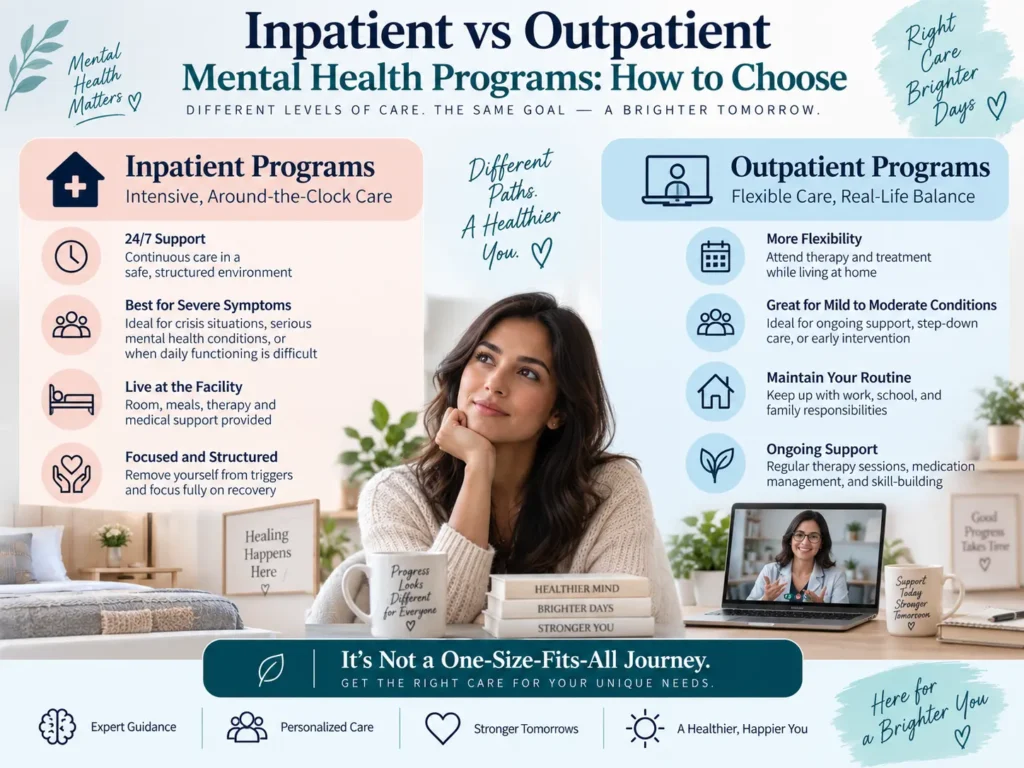
Inpatient vs Outpatient Mental Health Programs: How to Choose
When you go to a hospital for an inpatient mental health program, you get help under supervision 24 hours a day. Outpatient programs let you get treatment while you stay in your own home. The real difference is not where you sleep. It looks at whether you need medical and constant supervision to stay safe.
Most people who look for this question are trying to find a more specific answer: what does my situation really need? You don’t pick a level of care like you pick a hotel. A licensed clinician assesses risk, functioning, and your home environment, then recommends a level based on standardized criteria. Knowing those criteria ahead of time makes that talk a lot less scary.
Call 911 or text 988 to get help right away if you or someone you care about is in instant danger. To get to the Crisis Text Line, you can also text HOME to 741741.
Steps to Take for Better Mental Health Care
There is no choice between inpatient and community care. They are at opposite ends of a line that has four important stops on it. Most people move along that line over time.
ICUs for acute inpatient psychiatric hospitalization offer nursing and mental health care 24 hours a day, 7 days a week in a safe environment. Its job is to keep things stable during a crisis, not to cure a disease.
Residential treatment is also live-in, but less medically acute. It gives structure and supervision 24 hours a day, seven days a week for a longer period of time, generally weeks instead of days.
People who are in partial hospitalization, or PHP, get about the same clinical training every day as people who are in an inpatient unit, but they get to go home every night. Every week, it runs for at least 20 hours on most weekdays.
Intensive outpatient treatment, or IOP, offers structured group and one-on-one help several days a week. According to federal Medicare rules, it must be at least nine hours a week. Usually, it’s between nine and nineteen hours spread out over three to five days.
Outpatient treatment usually takes place once a week or every other week for an hour at a time.
Medication management means going to regular 15- to 30-minute meetings with a prescriber, sometimes along with therapy and sometimes by itself.
Most papers that talk about this subject only explain the first and last. The four in the middle are where most people fit, and the main reason people wait until they are in a crisis is that they don’t know they exist.
What Really Makes an Inpatient Different from an Outpatient
Continuous guidance, not overnight lodging, is what sets them apart.
Partially being hospitalized proves the point. People in PHP may get almost the same amount of therapy every day as people who are brought to a hospital unit. They may go to the same types of groups, talk to the same psychiatrist, and do the same amount of skill work. It’s still considered outpatient care because the person goes home at night and isn’t being watched by nurses all the time.
This is what a doctor really wants to know: can this person be safe for the next 24 hours without anyone watching? If the answer is yes, then some kind of outpatient care is right. The only question now is how thorough it should be. If they say no, that’s called being impatient.
The second difference has to do with the setting. Inpatient units are safer than homes because they are built to be that way, which is important when someone is in serious danger. Also, the person is taken out of their normal life, which is both a gain and a cost.
About how long each level lasts
Being locked up for months is the fear that comes up most often. The data doesn’t back that up.
According to the Healthcare Cost and Utilization Project of the AHRQ, the average length of stay in the hospital for someone with a primary mental health or drug use disorder was 6.4 days, while the average length of stay for someone without one was only 4.2 days. Days are used to measure acute psychiatric hospitalizations.
Usually, residential treatment lasts for a few weeks. Most of the time, partial treatment lasts for a few weeks. Intensive outpatient treatment usually lasts between a few weeks and a few months. According to SAMHSA’s clinical guidance, people should be in intensive outpatient treatment for at least 90 days, which includes the time when they start seeing their therapist less often. Regular outpatient therapy can last for years or months, and it should be most of the time.
Those numbers change how the choice is made. The time spent in inpatient care is short but intense. The floors below it is where the longer work takes place.
How to Choose a Level of Care
The suggestion is based on a structured review that looks at more than just symptoms.
Clinicians look at a person’s risk of hurting themselves or others, their functional status (like being able to work and take care of themselves), any medical or substance use problems that are happening at the same time as their mental health problem, their recovery environment (like having a stable place to live and family support), their treatment history and how they responded to it, and how involved and knowledgeable they are.
Those six areas are not random. The American Association for Community Psychiatry made the Level of Care Utilization System (LOCUS) to help make consistent placement choices. These are the aspects that LOCUS scores. CALOCUS-CASII, a form for kids and teens, covers the same ground for them. The ASAM Criteria, which is now in its fourth edition, do the same thing in six similar ways when it comes to addiction and co-occurring conditions.
It is really helpful to know that the instruments are available. It tells you the suggestion is not a sales decision, and it gives you something specific to ask about.
When it is medically necessary to stay in the hospital
Most of the time, inpatient care is needed when one of a few conditions is present.
Very likely to commit suicide or hurt themselves, especially if they have a plan, the tools to carry it out, or have already tried. Threat to hurt other people. Not being able to meet basic needs like food, housing, or self-care is sometimes called a grave disability. Acute psychosis or mania severe enough to impair judgment and safety. Withdrawal that needs to be managed by a doctor. And signs that haven’t gone away with lower levels of care or that can’t be kept safe there.
These same ideas—danger to oneself, danger to others, and not being able to take care of oneself—are at the heart of emergency hold laws across the US.
Do not wait for an assessment appointment if any of those things apply to you right now. You can call 988 or go to the emergency room closest to you.
When care outside of a hospital is enough and right
Outpatient levels are best for people who are not in immediate danger, can take care of themselves, have a safe place to go home to, and can consistently go to sessions.
The third case is the important one. Lots of people need a lot more than an hour of therapy a week, and they don’t need a hospital bed. To fill that gap, there are programs like intensive outpatient and partial hospitalization. Most people don’t even know there is a name for it.
There is more proof here than most people think. A systematic review by McCarty and colleagues, published in Psychiatric Services in 2014 and covering twelve studies from 1995 through 2012, found that multiple randomized trials and naturalistic analyses comparing intensive outpatient programs with inpatient or residential care produced comparable outcomes. The authors said there was a lot of evidence and suggested that health plans make intensive outpatient care a benefit that is covered.
There is a catch to that result, though: similar outcomes only happen when the placement is clinically right. Less intense doesn’t mean less effective as long as the level fits what’s needed.
One way to help is to step down
After an acute hospital stay, the goal is not to go straight home, but to go through a series of steps that get easier.
from being an inpatient to a partial hospitalization patient, then to an intensive outpatient patient, and finally to weekly therapy and continuing medication management. Each step keeps some order and oversight while letting people be more independent. In SAMHSA’s continuum approach, moving from one level to the next is based on successful transfers, a consistent treatment philosophy across all levels, and records that move with the person. This is exactly what goes wrong when steps are skipped.
People often skip steps, which is one reason why a lot of people end up being readmitted. Someone who was in trouble two weeks ago doesn’t get nearly as much help when they go from a hospital unit to a monthly appointment.
Why the weeks after giving birth are the most important
Take one thing away from this article: the hospital stay is not the most dangerous time. It’s the next month.
A study by Chung and others in JAMA Psychiatry looked at 100 studies and 17,857 suicides spanning 4.7 million person-years. They found that in the first three months after release, the suicide rate was 1,132 per 100,000 person-years, which is about 100 times the world suicide rate. The rate hit 2,078 per 100,000 patients who came in with suicidal thoughts or actions, which is about 200 times the global rate.
This is why it is an official way to judge health plans and hospitals. This measure keeps track of the percentage of people who are released from a mental health hospital who get a mental health follow-up within 7 days and within 30 days. The group that runs it makes it clear that timely follow-up can help people stay on their medications and treatment plans and lower their risk of suicide.
There should be a seven-day appointment on the calendar, medicine on hand, a written safety plan, and a way to keep medications and anything else that could be used for self-harm safe before someone leaves the hospital. Please ask for those in particular. When you do, you can name the measure.
Admission by choice and by force
Most mental admissions are chosen by the person. The person gives permission, helps plan their treatment, and can ask to be sent home, but generally only after a short clinical review period.
Every state and the District of Columbia also have an emergency hold law that lets someone be detained without their consent for a short time while they are being evaluated if they seem like a danger to themselves or others, and many states add the ability to care for oneself.
The details are very different. A study in the journal Psychiatric Services discovered that only 22 states require a judge to review the emergency hold process and only 9 require a judge to sign off on the commitment before hospitalization. Names, durations, and who may initiate a hold all differ, so check the rules where you live.
No matter what state you’re in, you should know two things. An emergency hold is only good for a certain amount of time and is not a promise. And any more involuntary treatment after that usually needs a new legal process with due process protections. Once they are stable, a lot of people who were admitted involuntarily change their status to voluntary.
How much insurance costs and what parity does
Some people don’t want to ask about cost, but that doesn’t make it go away.
The Mental Health Parity and Addiction Equity Act says that health plans that cover mental health must not be stricter than they are when it comes to financial requirements and treatment limits for medical and surgical care. In that group are limits that aren’t numbers, like prior permission, medical necessity review, and network standards.
KFF says that the law “does not itself require plans to provide BH benefits, nor does it require coverage of any particular treatment or condition.” It also says that Medicare is not affected by this law. The question of whether an advantage exists or not is not what equality is about.
Three details surprise people. Medicare only pays for up to 190 days of inpatient psychiatric care in a psychiatric hospital that is separate from a general hospital. This limit does not apply to a psychiatric unit inside a general hospital and does not apply to any other condition. In March 2025, MedPAC asked Congress to get rid of it.
Second, Medicare didn’t have an intensive outpatient benefit until January 1, 2024. That’s when it started, and it covered about 9 to 19 hours a week. Third, the federal No Surprises Act protects patients from balance billing for emergency services and for out-of-network care provided at in-network facilities, which matters when a crisis starts in an emergency room.
If your plan says no to a level of care, you can ask for a written list of the medical necessity factors it used and the exact reason it said no. You can also file an appeal.
Questions to Ask Before Making a Choice
Bring these questions with you to any talk about testing or getting in. The quality of the response tells you a great deal.
• What kind of care do you think they should get, and how did you decide there?
• What sort of days or weeks do most people in this program have?
• How long is the planned stay or program, and what defines it?
• Who is on the care team, and does a psychiatrist help decide what medications to give?
• What is the process for getting in touch with and meeting family members?
• How do we move on to the next step? Will we leave with an appointment in seven days?
• What will your insurance cover, and how much will it cost you out of pocket?
• Is this a psychiatric hospital that stands on its own or a unit inside a larger hospital?
For people on Medicare, the answer to that last question tells them if the 190-day lifetime limit applies.
How to Get an Evaluation
Before you call, you don’t have to make up your mind. The goal of an assessment is to figure out what level of care is best for you. A good assessment will be honest with you if the answer is a lower level of care or a different provider.
An admissions specialist should be able to confirm your benefits and talk about how much it will probably cost, as well as what to bring, how to fill out the paperwork for voluntary admission, and how family communication works. They should also be able to tell you what will happen if the assessment results are different from what you were hoping for.
Talk to an admissions officer for an honest opinion, and while you’re on the phone, ask the questions above.
Crisis Resources for the Nation
• 988 Lifeline for Suicide and Crisis. Call or text 988, or go to 988lifeline.org and talk to someone. Every day, 24 hours a day, it’s free, and no one will know. You can text and chat in Spanish, and there is a video phone service for people who are deaf or hard of hearing.
• Text Line for Crisis. Send the word HOME to 741741 or HOLA in Spanish.
• Veterans Help Line. Text 838255 or call 988 and press 1. Veterans, service members, members of the National Guard and Reserve, and people who support them are welcome. There is no need to enroll in the VA.
• Call the SAMHSA National Helpline. Call us at 1-800-662-4357. It’s free, private, available 24 hours a day, and you can get help and information in both English and Spanish.
If you need help right away, call 911 or go to the emergency room closest to you.
Questions People Ask Often
What’s the difference between mental health programs that you stay in and those that you go to?
People who can’t be safely cared for elsewhere can get 24-hour supervised care in a hospital through inpatient programs. Outpatient programs, which can be anything from weekly therapy to full-day programming, let you get treatment while you’re at home. The clinical line is whether or not constant supervision is needed to keep everyone safe.
Does outpatient treatment not work as well as inpatient therapy?
Not when the placement is appropriate. The results of studies that compared intensive outpatient programs with hospital or residential care were similar, according to a systematic review published in Psychiatric Services. It is important to note that this only applies to people who were already good candidates for outpatient care.
What do PHP and IOP mean?
People who are partially hospitalized get hospital-level care during the day, usually 20 hours or more a week, and then go home every night. Intensive outpatient care includes structured therapy a few times a week, which the federal government says must be at least nine hours a week. Both fall in the middle of weekly rehab and staying in a hospital.
How long does a typical psychiatric stay in a hospital last?
According to figures from the federal government, the average length of stay in the hospital for someone with a primary mental health or substance use disorder is 6.4 days. Days, not months, are used to measure acute mental health admissions. Their job is to stabilize things so that longer-term work can be done at lower levels of care.
Can I pick the level of care I get?
No, not really. A clinician looks at your risk, how well you’re performing, and your home environment, and then uses standard criteria to suggest a level. You can accept or decline treatment as long as there are no legal holds on it, but the recommendation is a clinical decision, and insurers use the same criteria when deciding whether to cover something.
If I don’t want to be accepted, what will happen?
Every state has an emergency hold rule that lets someone be detained without their consent for a short time while they are being evaluated if they seem dangerous to themselves or others. It’s just a short evaluation window, not a promise, and if the treatment continues against the person’s will, they will have to go through another court process. Once they are stable, a lot of people change their status to voluntary. Check the rules in your state.
Does insurance pay for both inpatient and outpatient mental health care?
What each plan covers varies. Federal parity law says that plans that cover mental health care can’t set limits that are stricter than those for medical care. However, it doesn’t say that plans have to give these benefits, and Medicare isn’t affected by it either. Before you join any program, make sure you know what the rewards are.
What should happen after I get out of jail?
When you leave, you should have a follow-up appointment within seven days, your medicine, a written safety plan, and a clear idea of the next level of care you should take. Plans and hospitals are officially judged on a 7-day and 30-day follow-up because the weeks right after release are the most dangerous.
