
Major Depression VA Rating: 2026 Guide to VA Disability Ratings
“A VA rating for major depression is based on how the condition affects your work, relationships, and daily functioning. VA disability ratings for depression range from 0% to 100%, depending on the severity of symptoms and level of impairment.”
If you are a Veteran with service-connected depression or major depressive disorder (MDD), you may be wondering how the VA determines your disability rating.
The major depression VA rating is not based simply on having a diagnosis or taking medication. VA evaluates the severity of the mental health condition and, importantly, how it affects your occupational and social functioning.
Under 38 CFR § 4.130, major depressive disorder is Diagnostic Code 9434 and is evaluated under the General Rating Formula for Mental Disorders. The current schedule provides ratings of 0%, 10%, 30%, 50%, 70%, and 100%.
There is also no single “average” VA rating for depression. Your rating depends on the evidence in your individual case, including the frequency, severity, and duration of symptoms and their effect on your daily functioning.
What Is the VA Rating for Depression?
VA does not assign a depression rating solely because a Veteran has been diagnosed with depression.
Instead, VA considers the overall level of impairment caused by the mental health condition. The rating criteria focus heavily on occupational and social impairment, rather than simply counting how many symptoms a person has.
For example, two Veterans could both have major depressive disorder but receive different ratings because their symptoms affect work, relationships, judgment, independence, and daily functioning differently.
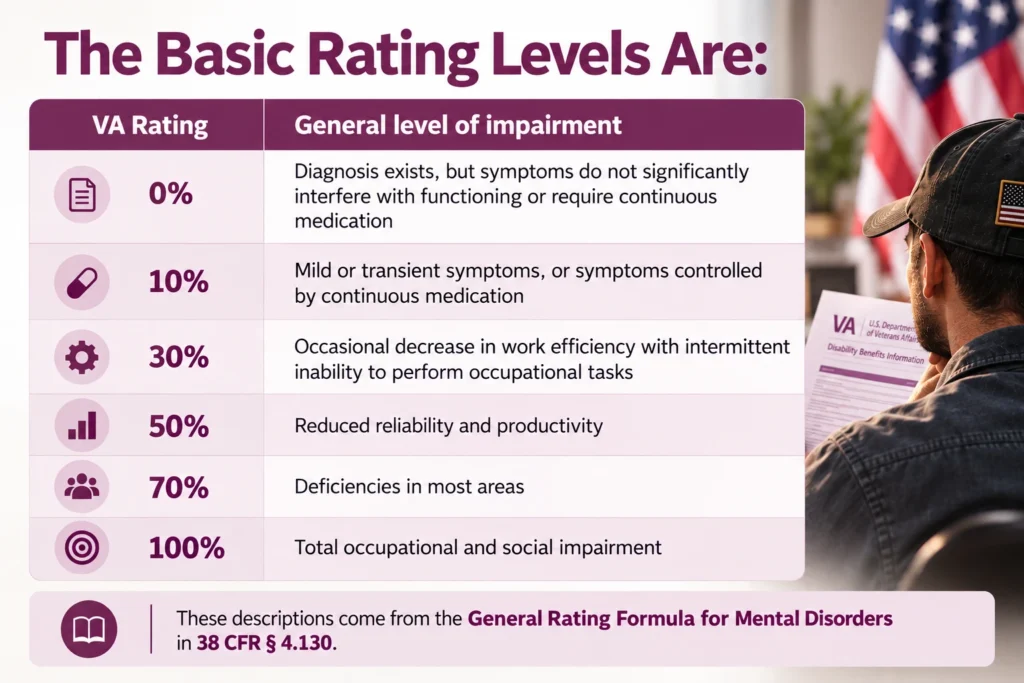
VA Depression Rating Chart: 0% to 100%
0% VA Rating for Depression
A 0% rating can apply when a mental health condition has been formally diagnosed, but the symptoms are not severe enough to interfere with occupational or social functioning and do not require continuous medication.
A 0% rating does not mean that the diagnosis is not real. It means the evidence does not establish compensable functional impairment under the rating schedule.
10% VA Disability Rating for Depression
A 10% rating generally applies when symptoms are mild or transient and decrease work efficiency during significant stress, or when symptoms are controlled by continuous medication.
Medication alone does not automatically guarantee a 10% rating. The overall evidence still matters.
VA regulations require consideration of the frequency, severity, and duration of psychiatric symptoms and the Veteran’s capacity for adjustment.
30% VA Rating for Depression
A 30% rating is associated with occasional decreases in work efficiency and intermittent periods of inability to perform occupational tasks, while the Veteran is generally functioning satisfactorily.
Examples in the regulation include:
- Depressed mood
- Anxiety
- Suspiciousness
- Panic attacks occurring weekly or less often
- Chronic sleep impairment
- Mild memory loss
The symptoms listed in the rating formula are examples rather than a checklist that must all be present. The overall disability picture is important.
50% VA Rating for Depression
A 50% rating reflects occupational and social impairment with reduced reliability and productivity.
Examples associated with this level include:
- Flattened affect
- Circumstantial or stereotyped speech
- Panic attacks more than once a week
- Difficulty understanding complex commands
- Short- and long-term memory impairment
- Impaired judgment
- Impaired abstract thinking
- Disturbances of motivation and mood
- Difficulty establishing and maintaining effective work and social relationships
Again, the presence of one symptom does not automatically establish a 50% rating. VA considers the complete evidence and the level of resulting impairment.
70% VA Rating for Major Depression
A 70% rating represents a substantially greater level of impairment.
The regulation describes occupational and social impairment with deficiencies in most areas, such as work, school, family relations, judgment, thinking, or mood.
Examples include:
- Suicidal ideation
- Obsessional rituals that interfere with routine activities
- Intermittently illogical or irrelevant speech
- Near-continuous panic or depression affecting independent functioning
- Impaired impulse control
- Spatial disorientation
- Neglect of personal appearance and hygiene
- Difficulty adapting to stressful circumstances
- Inability to establish and maintain effective relationships
Suicidal ideation is particularly important. If you experience suicidal thoughts, tell your healthcare provider and seek immediate support when necessary. A VA disability claim should never take priority over immediate safety.
100% VA Rating for Major Depressive Disorder
A 100% schedular mental health rating requires total occupational and social impairment under the current General Rating Formula.
Examples listed in 38 CFR § 4.130 include:
- Gross impairment in thought processes or communication
- Persistent delusions or hallucinations
- Grossly inappropriate behavior
- Persistent danger of hurting yourself or others
- Intermittent inability to perform activities of daily living
- Disorientation to time or place
- Severe memory loss involving close relatives, occupation or one’s own name
The 100% criteria describe a very severe level of impairment. A diagnosis of MDD by itself does not establish a 100% rating.
What Is the VA Rating for Major Depressive Disorder (MDD)?
Major depressive disorder has Diagnostic Code 9434 under the VA Schedule for Rating Disabilities.
Importantly, MDD does not have a completely separate percentage scale from other mental disorders. The condition is evaluated using the General Rating Formula for Mental Disorders in 38 CFR § 4.130.
This means searches such as “MDD VA rating,” “major depressive disorder VA disability,” and “VA rating for major depressive disorder” generally lead to the same underlying rating framework.
The diagnosis matters, but the severity and functional consequences of the condition are critical to the evaluation.
Is There an Average VA Rating for Depression and Anxiety?
There is no official average VA rating for depression and anxiety that can predict what an individual Veteran will receive.
Depression and anxiety can occur together, and both conditions fall within the mental health rating framework. VA looks at the overall occupational and social impairment supported by the evidence.
The Mental Disorders DBQ itself asks the examiner to identify the overall level of occupational and social impairment associated with all mental diagnoses. It also asks whether impairment can be differentiated between individual mental disorders.
Therefore, searching for an “average VA rating for depression and anxiety” can be misleading. The more useful question is:
How do depression and anxiety affect your ability to work, maintain relationships, think clearly, function independently, and manage everyday responsibilities?
How Does VA Rate Depression and Anxiety Together?
When a Veteran has both depression and anxiety, the VA does not simply add two mental health percentages together.
The same symptoms generally cannot be evaluated more than once under different diagnoses. This principle is known as avoiding “pyramiding.”
For example, if depression and anxiety both contribute to sleep problems, concentration difficulties, and reduced work performance, those overlapping manifestations generally cannot simply be counted twice.
This is why a VA rating for depression and anxiety depends on the complete disability picture rather than adding a separate percentage for each diagnosis.
The VA’s current Mental Disorders DBQ specifically asks the examiner to evaluate occupational and social impairment related to all mental diagnoses and whether the effects of different disorders can be separated.
What Evidence Can Support a VA Depression Claim?
A strong claim should be supported by evidence that helps establish both the condition and its connection to military service.
Depending on the circumstances, relevant evidence may include:
- Mental health treatment records
- Psychiatric evaluations
- Service treatment records
- Medication history
- Statements describing symptoms and functional limitations
- Statements from people who have observed changes in your behavior
- Relevant employment or educational records
- Previous VA examination reports
- Other competent medical evidence
VA’s evidence requirements vary depending on the claim. Veterans can file claims online, by mail, in person, or with assistance from an accredited professional.
For mental health conditions, VA also recognizes conditions such as major depressive disorder and generalized anxiety disorder in its claim documentation.
What Is a Mental Disorders DBQ?
A Disability Benefits Questionnaire (DBQ) is a standardized VA examination document used to collect information relevant to disability evaluations.
The public Mental Disorders DBQ asks about areas including mental health history, occupational and educational history, symptoms, and the level of occupational and social impairment.
A DBQ is not itself a guarantee of a particular rating. The VA evaluates the examination report together with the rest of the evidence.
It is also important to distinguish a DBQ from a medical opinion. A medical opinion may address questions such as whether a condition is related to military service, while the DBQ focuses on clinical findings and functional impairment relevant to the evaluation.
What Happens During a VA C&P Mental Health Examination?
A Compensation & Pension examination may involve discussion of:
- Your current symptoms
- Mental health history
- Treatment and medication
- Work history
- Relationships
- Daily functioning
- Relevant military experiences
- How symptoms affect your ability to function
The VA rating decision is not supposed to depend only on how you appear during one C&P examination. The regulations require consideration of the evidence of record and the frequency, severity, and duration of symptoms.
Be honest and specific. Do not minimize symptoms because you have become accustomed to living with them, but do not exaggerate them either.
Can Your Depression VA Rating Increase?
Yes. A Veteran may seek an increased rating when a service-connected mental health condition has worsened.
The important issue is whether the evidence supports a greater level of occupational and social impairment under the applicable criteria.
If your condition has changed, keep records of relevant treatment, symptoms, and functional problems. Your evidence should describe what has actually changed rather than simply stating that your condition is “worse.”
Can Depression Be Secondary to Another Service-Connected Condition?
In some cases, depression may be claimed as secondary to another service-connected disability.
For example, a Veteran may develop significant mental health problems in connection with the effects of a chronic physical condition. Whether secondary service connection is warranted depends on the facts and medical evidence in the individual case.
The key is to establish the required relationship between the current mental health condition and the service-connected condition.
Common Mistakes Veterans Should Avoid
Having MDD or another depressive disorder is important, but the rating focuses on the resulting impairment.
Treating the Rating Table Like a Checklist
The examples under each percentage level are not intended to mean that you must have every listed symptom to qualify for that level. VA evaluates the overall disability picture.
Assuming Medication Determines the Rating
Medication is relevant, but it does not automatically determine a specific percentage.
Ignoring Functional Problems
Explain how depression affects work, relationships, concentration, motivation, sleep, personal responsibilities and everyday activities.
Assuming Depression and Anxiety Are Simply Added Together
Overlapping manifestations generally cannot be rated twice under separate diagnoses.
Relying on One Examination Alone
VA considers the evidence of record, not just a snapshot from one examination.
What Should You Do If You Are Considering a VA Depression Claim?
Start by understanding what you are actually claiming and what evidence supports it.
Review your medical records, document your current symptoms, gather relevant service and post-service evidence, and consider getting help from an accredited VA representative when you need assistance with the claims process.
If you are still gathering evidence, VA’s Intent to File process can establish a potential earlier effective date. VA states that an intent to file generally gives you one year to complete the claim.
If you need treatment for depression, you should also seek appropriate mental health care. VA provides depression treatment options including medication and psychotherapy.
Conclusion
The major depression VA rating is based on the severity of the condition and, especially, its effect on occupational and social functioning.
Major depressive disorder is evaluated under the General Rating Formula for Mental Disorders, with current ratings ranging from 0% to 100%. Depression and anxiety are not simply assigned separate percentages and added together when their manifestations overlap.
The most useful evidence is evidence that clearly describes your diagnosis, symptoms, history, and real-world functional impairment.
If you are unsure about your symptoms or diagnosis, consider speaking with a qualified mental health professional. If you need help understanding the VA claims process, an accredited VA representative, attorney, or Veterans Service Organization can provide claims-specific guidance.
For mental health care, treatment should remain the priority. Depression is treatable, and the VA offers evidence-based treatment options for Veterans.
Need Help Understanding Your Mental Health Symptoms?
Speak with a qualified mental health professional about your symptoms and treatment options.
Frequently Asked Questions About VA Depression Ratings
Major depressive disorder is evaluated under the General Rating Formula for Mental Disorders. Current schedular evaluations are 0%, 10%, 30%, 50%, 70% and 100%, depending on the resulting level of occupational and social impairment.
Yes. A 70% evaluation is possible when the evidence supports occupational and social impairment with deficiencies in most areas, such as work, family relations, judgment, thinking or mood.
A Mental Disorders Disability Benefits Questionnaire is a standardized VA examination document that collects information about mental health history, symptoms and occupational and social impairment.
Yes, but the current 100% criteria require total occupational and social impairment. A diagnosis of major depressive disorder alone does not automatically result in a 100% rating.